Wheel Iron Remover: Best Brake Dust Cleaner USA
Table of ContentsWhat Is a Wheel Iron Remover?How Does a Wheel Iron Remover Work ?Signs Your Wheels Need an Iron RemoverBenefits of Using a Wheel Iron RemoverWhere can you use…
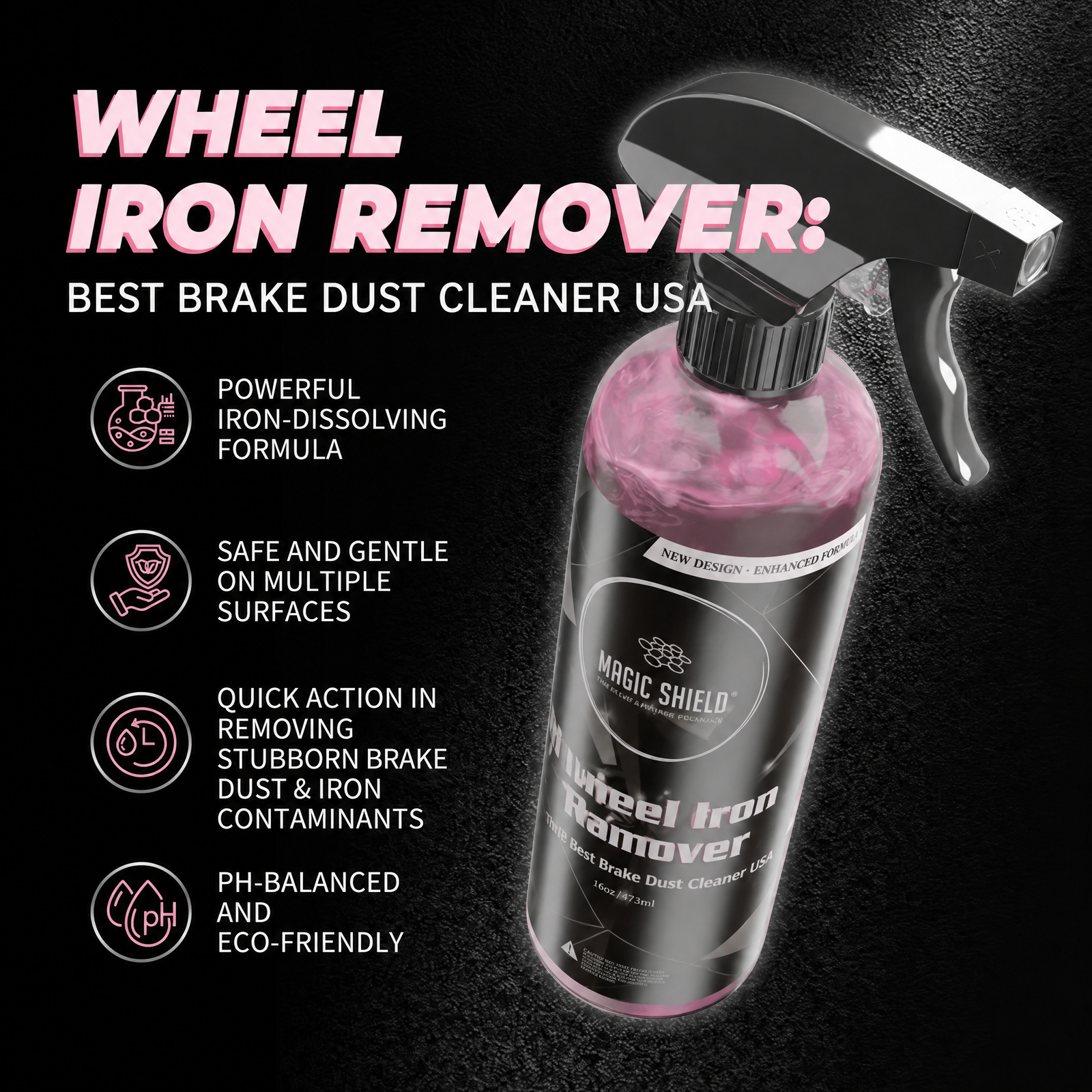
Table of Contents
Every time you drive, your wheels are kind of under attack without you even noticing. Tiny metallic particles from brake dust, road grime , and industrial pollution end up embedding themselves deep into wheel surfaces , and the usual car washing just can’t reach them in a meaningful way. Over time those little bits can corrode your wheels from the inside out, leading to rust-like staining, surface pitting , and damage that can’t really be “washed away” later. And yeah, that also means your car’s overall value tends to take a hit.
So what’s the fix? A professional-grade Wheel Iron Remover, basically the most effective and science-backed step in any detailer’s setup. Whether you’re a daily commuter in Chicago, a car person in Los Angeles, or you’re working as a professional in Miami, using a Wheel Iron Remover is the one move that helps protect, clean, and restore your wheels in a way routine washing simply doesn’t match.
In this guide, we’ll go over everything you should know about Wheel Iron Remover products — how they work, when to use them, and why magicshield.shop is the go-to brand for American drivers who want truly professional results, not half measures.

What Is a Wheel Iron Remover?
A Wheel Iron Remover is a specialized chemical decontamination spray meant to dissolve and lift ferrous, iron-based particles that stick to wheel surfaces during regular driving. These particles typically come from brake pad dust, rotor wear, rail dust, and that general environmental fallout — and once they’re bonded in, they’re mostly invisible to the naked eye.
Unlike standard wheel cleaners that mainly handle surface grime, a Wheel Iron Remover runs on a chemical reaction that actively “finds” and neutralizes iron contamination at a molecular level. It’s like the difference between wiping a grimy window with a dry cloth, versus using a real glass cleaner — only this time, it’s a lot more dramatic, and honestly more necessary.
Detailers usually call the whole process wheel decontamination, and it’s widely considered essential before you apply anything like wax, sealant, or a ceramic coating.
How Does a Wheel Iron Remover Work ?
So the whole idea behind a Wheel Iron Remover is honestly pretty cool, like it’s both science and a bit of “wow” when you see it happen. And yeah, the chemistry behind it is impressive too.
When you spray the product on your wheels, the active ingredients— usually iron-binding or iron-chelating agents, like thioglycolic acid or ammonium thioglycolate— react chemically right on contact with ferrous particles that are stuck on there. Those iron particles get broken down, then effectively dissolve and are carried away, suspended in the liquid, so you can rinse them off safely.
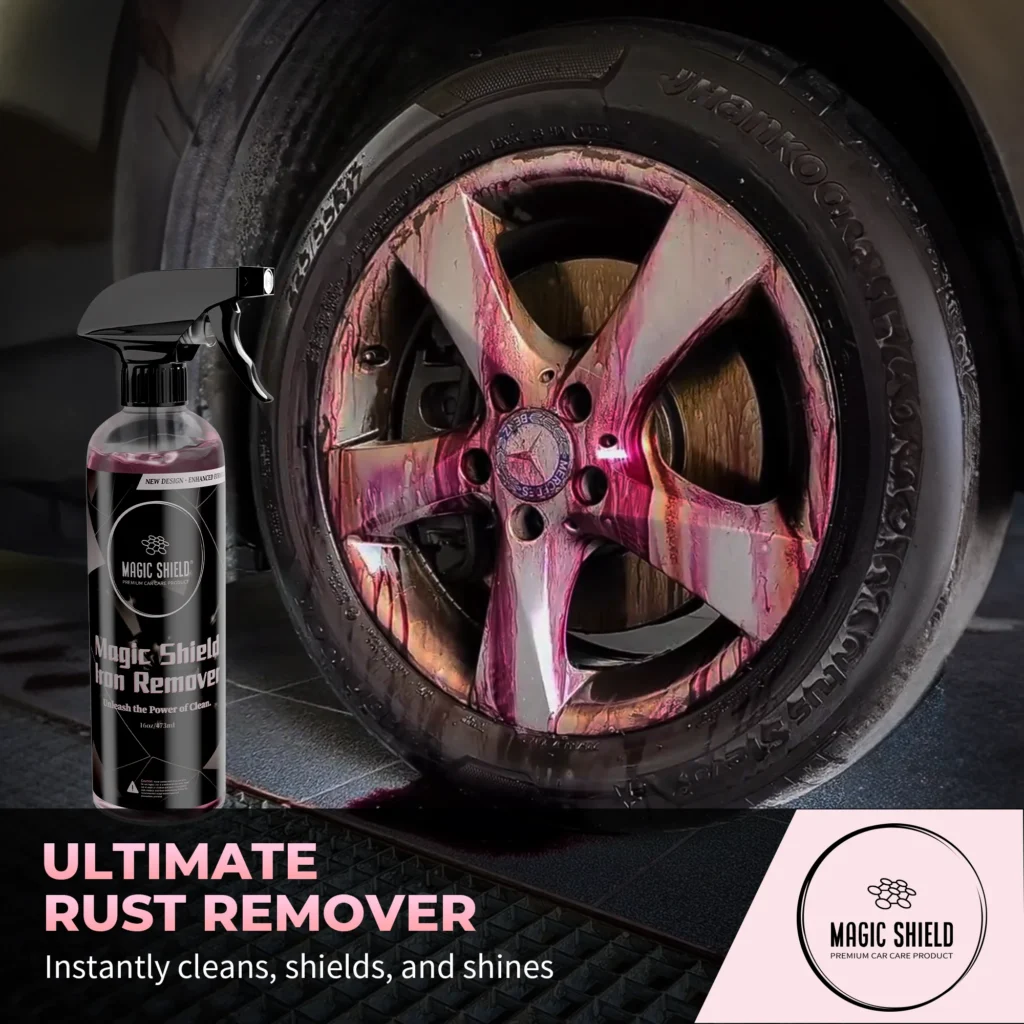
And here’s part of why it feels so satisfying: most quality iron remover sprays use a color-changing formula. As the product reacts, it shifts into a deep purple or red tone. That change is like a quick map, it shows you where the contamination is, and it also tells you the product is actually doing something. If you’re seeing more purple, then more iron was hiding on your wheel faces and edges.
When used the way the label says, the reaction is safe , and it should not leave anything harmful behind. You end up with wheel surfaces that are decontaminated and ready for whatever protection you’re planning next.
Signs Your Wheels Need an Iron Remover
Still not sure your wheels need a decontamination step? Watch for these common “tells”:
Heavy brake dust buildup — If you’ve got a thick gray-black layer on the spokes and the barrel , and normal washing just won’t budge it.
Brown or orange contamination spots — little rust-colored dots that seem embedded in the wheel finish, often mistaken for chipped paint or some kind of permanent mark.
Dull-looking wheels — Even after a wash your wheels still look hazy or flat, because iron fallout is messing with the way light reflects.
Rough wheel surfaces — If your finger glides over a supposedly clean wheel and it feels like fine sand , that can be embedded iron.
Difficult-to-remove dirt — When brake dust returns faster than usual or resists standard cleaning, iron contamination may be creating a kind of attraction surface that pulls in more debris later.
If your wheels are showing a few of these symptoms, an iron remover can be a smart next step, rather than repeatedly scrubbing and hoping.
Benefits of Using a Wheel Iron Remover
Using a Wheel Iron Remover, especially a professional one, gives you more than wheels that just look clean. It’s kinda like you’re doing the real work underneath, not only the glossy stuff. Here’s the deal you can expect, usually pretty fast:
- Breaks down embedded iron particles — not only surface level, it works in a more chemical way to neutralize ferrous contamination that normal brushes and soap never really touch.
- Brings back wheel shine — after the iron is gone, the wheels catch the light right again, and they look almost brand new.
- Helps stop corrosion and rust — those trapped iron bits can oxidize , then start spreading rust under your wheel’s coating. Removing them basically stops the whole cycle.
- Works well with alloy and painted wheels — a solid pH-balanced iron fallout remover should stay gentle with clear coats, anodized finishes, and painted wheel surfaces.
- Gets wheels ready for ceramic coating — ceramic coatings bond best to properly decontaminated surfaces. If you skip the decon phase, bonding is weaker, so performance and durability take a hit.
- Makes future cleaning less annoying — when there’s no embedded iron layer acting like a contamination magnet, brake dust comes off easier in later washes.
Where can you use a wheel iron remover?
Honestly, one of the nice things about a solid wheel iron remover is how many places it can show up. It isn’t only wheels, or just “wheels” I mean:
Alloy wheels — the most everyday application; it lifts brake dust and iron fallout from cast and forged alloy wheels in a safe way
Chrome wheels — it decontaminates gently , helps you avoid harming the chrome finish or making weird water spots
Painted wheels — good for factory-painted OEM wheels and for aftermarket powder-coated wheels, if you use it exactly like the label says
Brake calipers — removes that baked-on brake dust that collects on painted or bare metal calipers between brake services
Exterior painted surfaces — surprisingly yes, you can use a wheel cleaner that’s built for iron removal on painted body panels too, as a full-car decontamination step before polishing or applying a coating
How to use a wheel iron remover
Using it is pretty straightforward, and it’s one of those tasks that feels small but pays off. Just follow the order below for better results :
Step 1: Rinse the wheels
Begin with cool wheels — never apply to hot brakes or wheels sitting in direct sun. Rinse well with a pressure washer or a garden hose, so you knock off loose grime, mud, and surface brake dust. That way, you reduce the chances of scratching during the next phase, kind of a big deal.
Step 2: Spray the product evenly
Give the bottle a good shake, then spray an even layer across the whole wheel area — spokes, barrel, around lug nuts, and the inner barrel if you can reach it. Don’t hold back too much, full coverage usually means better chemical action.
Step 3: Wait for the color shifting reaction
This part is satisfying. Let it sit for about 3 to 5 minutes (don’t let it dry). You’ll notice the liquid turns purple wherever iron contamination is present. If the buildup is worse, the color shift looks more dramatic, in general it’s more vivid.
Step 4: Agitate with a Soft Wheel Brush
Use a dedicated soft-bristle alloy wheel cleaner brush to gently agitate the product into crevices, lug holes, and tight spoke areas. This helps the formula reach deeper contamination and ensures full coverage.
Step 5: Rinse Thoroughly
Rinse the wheel completely with a strong stream of water, washing away all dissolved iron and product residue. Inspect the wheel — if heavy contamination remains, repeat the process. Finish with a wheel sealant or tire dressing for added protection.
Wheel Iron Remover vs. Traditional Wheel Cleaner
| Feature | Wheel Iron Remover | Traditional Wheel Cleaner |
|---|---|---|
| Removes iron particles | ✅ Yes — chemically dissolves | ❌ No — only surface cleaning |
| Handles brake dust | ✅ Deep decontamination | Partial — surface brake dust only |
| Color-changing indicator | ✅ Shows contamination level | ❌ No indication |
| Safe for all finishes | ✅ pH balanced options | Varies — some are acidic |
| Used before coating | ✅ Required step | ❌ Not sufficient |
| Frequency of use | Monthly to quarterly | Every wash |
Traditional wheel cleaners are great for routine wash maintenance, but they cannot penetrate or neutralize embedded ferrous contamination. For true wheel decontamination, an iron fallout remover is the only option.
Wheel Iron Remover vs. Clay Bar
Both a Wheel Iron Remover and a clay bar are decontamination tools, but they work very differently and serve complementary roles:
A Wheel Iron Remover dissolves iron chemically — it targets ferrous particles specifically and neutralizes them through a liquid formula. A clay bar, on the other hand, works mechanically — it physically shears surface contaminants away through abrasive action.
The best practice? Use your iron remover for wheels first to chemically dissolve iron particles, then follow with a clay bar to mechanically pull away any remaining non-ferrous contaminants like tar, tree sap, or paint overspray. Together, they deliver a completely decontaminated surface.
How Often Should You Use a Wheel Iron Remover?
The right frequency depends on your driving conditions:
- Light drivers / garage-kept cars: Every 3 to 4 months
- Daily commuters: Monthly, especially in urban environments
- Performance or sports car drivers: Every 4 to 6 weeks due to high brake dust output
- Winter climates (salt belt states): Before and after winter season at minimum
- Before any wax, sealant, or ceramic coating: Always, without exception
If your wheels are visually showing contamination spots or feel rough to the touch, that’s your signal — don’t wait for the schedule
Why choose magicshield.shop Wheel Iron Remover ?
Honestly, when you’re shopping for pro wheel cleaner products here in the USA, it’s not like every iron remover is the same, not even close. Here’s what makes magicshield.shop feel a bit different, and yeah, kinda better than the usual options:
A professional-grade formula — built using the active chemistry that professional detailers and automotive reconditioning shops across America already rely on, day after day.
Quick iron removal tech — the solution starts working within 60 seconds, so you’re spending less time fussing and more time finishing the job.
Gentle on every wheel finish — pH balanced to help protect clear coat layers, anodized surfaces, chrome, painted wheels, and even brake calipers.
Made for brake dust removal — optimized for the ferrous brake fallout you typically see from American vehicles, especially with real day to day driving.
Built for American road conditions — whether it’s road salt in Buffalo, industrial fallout floating around near Pittsburgh, or nonstop brake dust from heavy traffic in Los Angeles, our best wheel iron remover formula is engineered to handle all that, without much drama.
FAQs:
What does a wheel iron remover do ?
A wheel iron remover is basically a chemical decontamination spray that breaks down ferrous , iron-based specks that are stuck in wheel surfaces. These specks usually show up from brake pad dust, rotor wear , and that random environmental fallout stuff. The spray chemically neutralizes those particles and helps loosen them , so you can rinse everything away pretty easily. In the end it restores the wheel surface and helps reduce corrosion risk
Is wheel iron remover safe for alloy wheels?
Yes, if you’re using a good, pH balanced wheel iron remover, it’s safe for alloy wheels. This includes cast aluminum, forged aluminum , and even anodized finishes. Still, you should always check that the product is pH neutral, and stick to the manufacturer’s dwell time instructions, just to avoid any chance of surface irritation or weird streaking
How often should I use an iron remover on my wheels?
For most daily drivers , once a month is usually perfect. If you drive a performance car or you’re in heavy traffic urban areas , bi-weekly may be better , depending on how quickly the grime appears. At minimum, use a wheel iron remover every time you apply wax sealant , or a ceramic coating, because you want a clean bonding surface , not a contaminated one
What is the best Wheel Iron Remover in the USA?
The best Wheel Iron Remover for American drivers combines fast-acting iron-chelating chemistry, a clear color-change indicator, pH-balanced safety for all wheel types, and compatibility with the brake dust profiles generated by US vehicles. magicshield.shop offers a professional-grade formula specifically engineered for American driving conditions — making it a top choice for both DIY enthusiasts and professional detailers.
Can Wheel Iron Remover prevent wheel corrosion?
Yes — indirectly but powerfully. Embedded iron particles oxidize over time, creating rust that spreads beneath wheel coatings and causes corrosion pitting. Regularly removing these particles with a Wheel Iron Remover eliminates the source of this corrosion before it can take hold. Pairing iron removal with a quality wheel sealant or ceramic coating provides maximum long-term corrosion protection.